Sunday, June 13, 2010

The Big Buddha on Lantau Island


Go to Big Buddha, they said.

Ok, we said.

We took the metro for a 25-minute ride, then got onto this cable car for another 25 minutes.


The view was stunning. In every direction.


Down below we could see the conical hats of fishermen and fisherwomen working on the shore. Were they clamming? Were they crabbing? It was a hot and humid day, and we fanned ourselves as we glided over their toil.

Eventually the Buddha came into view. Can you see it?


There he was, residing over one of the many verdant hills of Lantau Island. The low clouds looked like incense.


To get to the Buddha, you must first pass through a commercial "village" that is packed with gelato shops and restaurants and gift shops and Starbucks.

There is even an interactive ride/show where you can pay to get closer to the Buddha.
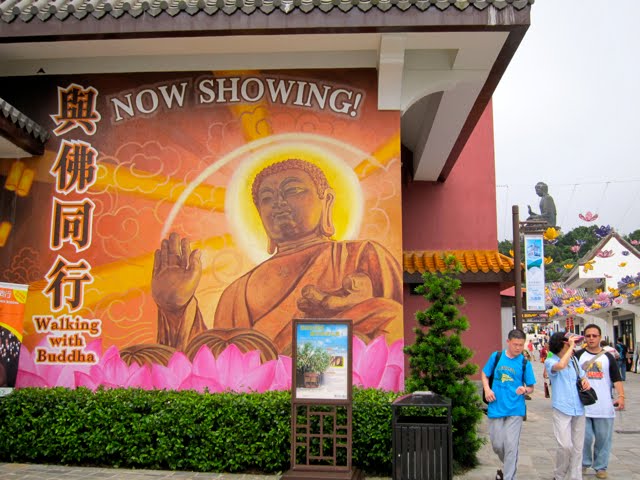

It gets worse. There is a fake tree called the Bodhi Wishing Tree, and you can write down a wish and place it there. Which sounds ok, until you read that to get the tag you must spend HK$150 at the gift shop.


I would love to know what the monks at the Po Lin Monastery think of all this.

But once you get past the commercial strip, you arrive at the base of the Buddha, and as yet there are no air-conditioned escalators to whisk you to the top.


It's not such a long walk after all, and at the top there's a cool breeze to reward you for your efforts.


Everyone wants to get their picture taken with the Buddha.


Wouldn't you?


Afterwards we went to the Po Lin Monastery, where the monks are very used to the presence of outsiders.


They served a basic vegetarian meal that happened to include one of my all-time favorite dishes: baby bok choi and mushrooms.


They also served up some wisdom.


After the meal we sat in the courtyard, listening to their chanting and watching the many birds and enormous black butterflies flit around.


Filled up on peace, it was time to head back.


Thursday, June 10, 2010

Can You Name the Third Largest City in China?


Shenzhen, China, population 14 million, is one of the largest cities you've probably never heard of. But the electronic goods you are no doubt surrounded by--and perhaps are using to read this very post--most likely were created and assembled here. Motorola, Sony, Apple, Dell, Hewlett-Packard, Nokia . . . the list goes on and on.


It's amazing that so few of us westerners have been here or even heard of it, especially considering it's next door to the much-visited Hong Kong. In fact, you can literally take the subway right up to the border, hop off and walk through border control, then hop on the other city's subway on the other side.

But aside from business folk, you don't see too many people doing that. And the portal between the two cities can feel like a passage to another world.


It's a city of the young. As soon as kids are old enough to leave their village, the brightest and most ambitious, most entrepreneurial, flock here to try and make a new life for themselves.


As one person told me, "Shenzhen is where you go to become whoever it is you want to be."


It's part of a Special Economic Zone established by Deng Xiaoping in 1979, as part of the larger "Reform and Opening" initiative. Really, it's capitalism meets communism, and that makes for a wicked, fascinating, hopeful, and often heartbreaking combination.


It's a tale of two cities.

The interior, where we stayed, is bright and modern, with an ultra-sleek subway system, networks of high-end malls, and Starbucks, KFCs, 7-11s and McDonalds spreading everywhere ("like germs," said one local resident).


High-rises are going up--and old ones coming down--everywhere you turn. And in Shenzhen, "old" means more than five years. Consider that in 1979, this place was little more than a fishing village. 30 years and 14 million people later, it feels like everything and everyone was made just yesterday. That's probably because they were. At 32, I'm not just older than this city, I'm also older than most of the people who live here and run this place.


In between all those high-rises it's still China. Fortune tellers dot the sidewalk beside the metro. Old grandmas pull wooden carts loaded with rice and drinking water. Babies wear split britches rather than diapers and are held over bushes when they need to pee. Police officers are everywhere, usually on bikes with flashing red and blue lights.


When Mike and I walk along the side streets, we are the only white faces, even here in the city center. Folks are not shy about staring. One group of school boys called out "hello," and when we said "hello" back they collapsed into giggles.


To live or work in inner Shenzhen, you need special papers. There is a wall that separates inner Shenzhen from outer Shenzhen, which is where all the factories are, and there are a series of checkpoints that locals tell us are becoming less and less strictly enforced. Whenever we drove through them we saw police officers with big machine guns, but were never stopped or saw others being stopped.


Once you pass through to the other side, the construction of roads and building escalates to an unimaginable frenzy. It feels like it's going so fast, there might even be workers five feet ahead of you laying the very cement you'll be driving on.


It also gets considerably less clean.


But everyone is working very, very, very hard to build a better life for themselves.


This obviously bootlegged book was being sold in a stall outside one of the many Wal-Marts in Shenzhen.


And if they can't achieve it in their lifetime, then there is always the hope that maybe it will be different for their children.


Once you go here and meet the people, who are warm and friendly and full of hope, you not only begin to share in that dream--you start to realize the true depth of interconnectivity and responsibility we in the west have to help make those dreams come true.


Wednesday, June 9, 2010

Dispatch From Foreign Devil in Fragrant Harbor


Woot! In case the picture didn't give it away, we're in Hong Kong now. Last night we even saw a Kung Fu film in a theater just off the bustling street you see above.

We spent most of last week in mainland China (post to follow), and though we found it surprisingly easy to get around despite our complete lack of Mandarin, it's great to be back in Hong Kong, where folks are used to English even if they don't speak it, and nobody stops to stare at me when I'm out on the street.

Here are just a few of the things I like in Hong Kong...

The Chi Lin Buddhist Nunnery


A lot of the pictures you'll see of it online crop out the high-rises that surround it, but to me the fact that this sacred place is in the middle of Hong Kong's hustle and bustle is exactly what makes it so great. And you can tell that the gardeners are working with the skyline rather than trying to ignore it.


Apparently it's the world's largest structure created entirely without nails. The above, of course, is a picture of the garden, because taking photos in the interior is forbidden. But I can tell you it's a very welcoming and serene place, with its ornate woodwork and its many golden Buddhas and bodhisattvas, and the sound of a young nun singing reminded me of when we were visiting a museum in Istanbul that was said to contain some of Islam's sacred relics. As we walked through the exhibit, the whole thing was underscored by an imam we couldn't see who stood on the other side of a wall and continually sang the Koran. It was lovely.


The Subway System


Both here and in mainland China, the subway systems are extraordinarily fast and efficient, even for English speakers like us. It makes me feel simultaneously embarrassed and sorry for everyone who comes to New York and expects we'll offer something similar. Instead we give them enormous rats and constant service interruptions and announcements that even the natives can't understand. Sigh.


Bamboo


It's used instead of metal poles for scaffolding everywhere, even on the fanciest building projects. Which makes sense, since it's lightweight yet incredibly strong, and readily available. Hell, bamboo is so versatile it can be made into paper, into clothing...it can even be eaten. What a useful plant!


Night Markets


China really does nighttime well. Everything and everyone comes alive, and there's a market to match whatever mood you're in. Electronics, lingerie, luggage, teacups, jewelry, Mao-morabilia...

Of course, we're on the road for months, so we are both strongly disinclined to buy even the smallest of souvenirs. But we can take pictures!


(This is Mike's new nickname.)

And we can eat!


Here we are at the Temple Night Market, and that's one of the many "Beer Girls" in the background wearing the red and white stripes. She tried to get us to buy her company's brand (San Miguel) and was very disappointed when we went with Tsing Tao instead.


The Star Ferry


It connects Hong Kong island with Kowloon (which is where we're staying) and is a romantic, swift, and cheap way to make the crossing.


Our Hotel


This place is ridiculously comfortable, the rooms stunningly designed, and there's a pool with glowing and twinkling lights that cycle through overhead while you're floating on your back and thinking about how to resist the siren call of room service. Also, a sauna. Also, a steam room. Also, a shower with one setting marked "fresh" and one marked "fun" that uses six different shower heads and many lights and varying textures and temperatures of water to give you experiences that are, indeed, both fresh and fun.